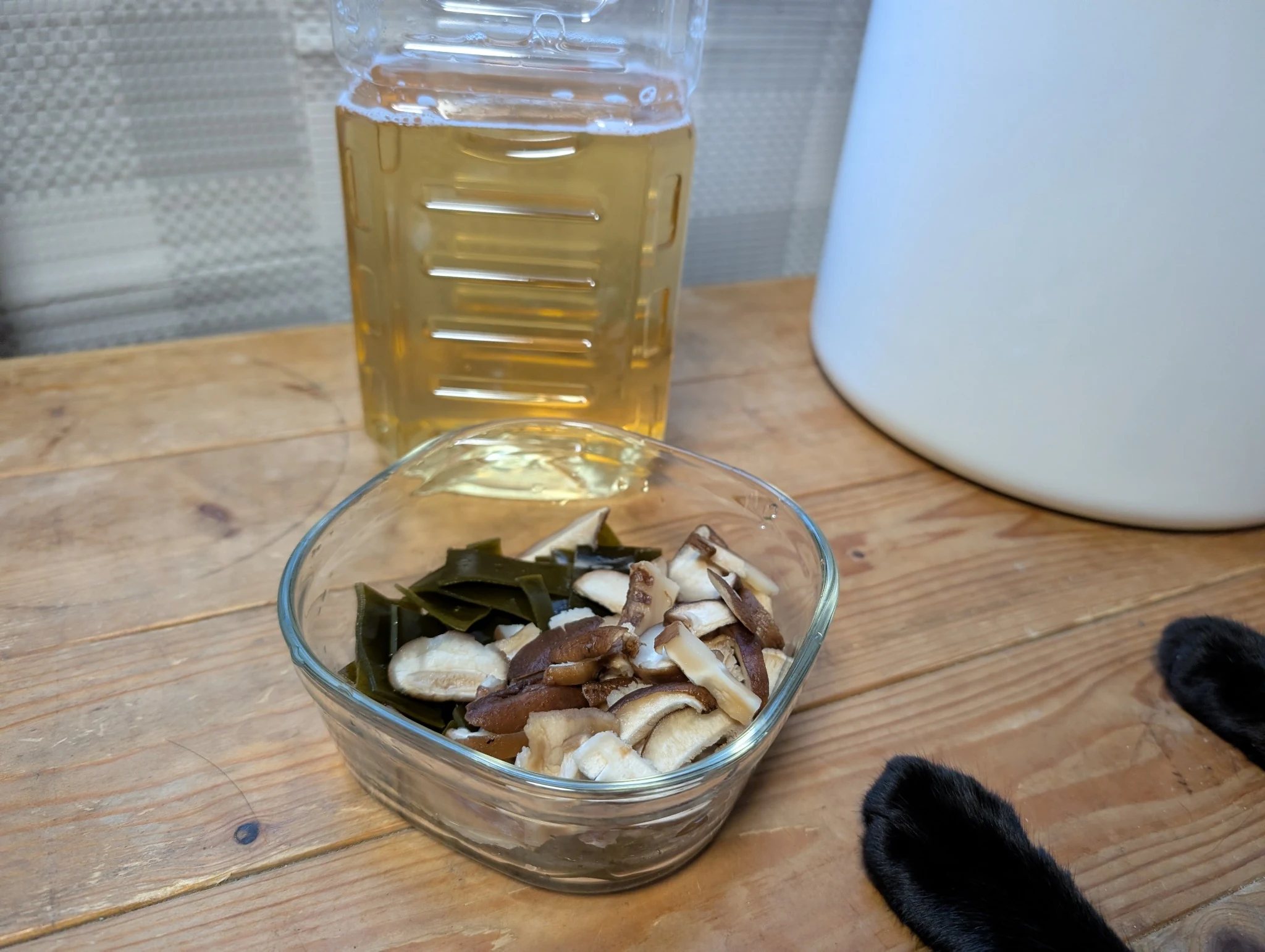
At home, I make this by putting kombu and dried shiitake in cold water and leaving the container in the refrigerator. It's almost entirely hands-off. Once the stock has had time to steep, I take out the kombu and mushrooms and use the liquid for miso soup, simmered vegetables, noodles, or whatever I'm cooking that day.
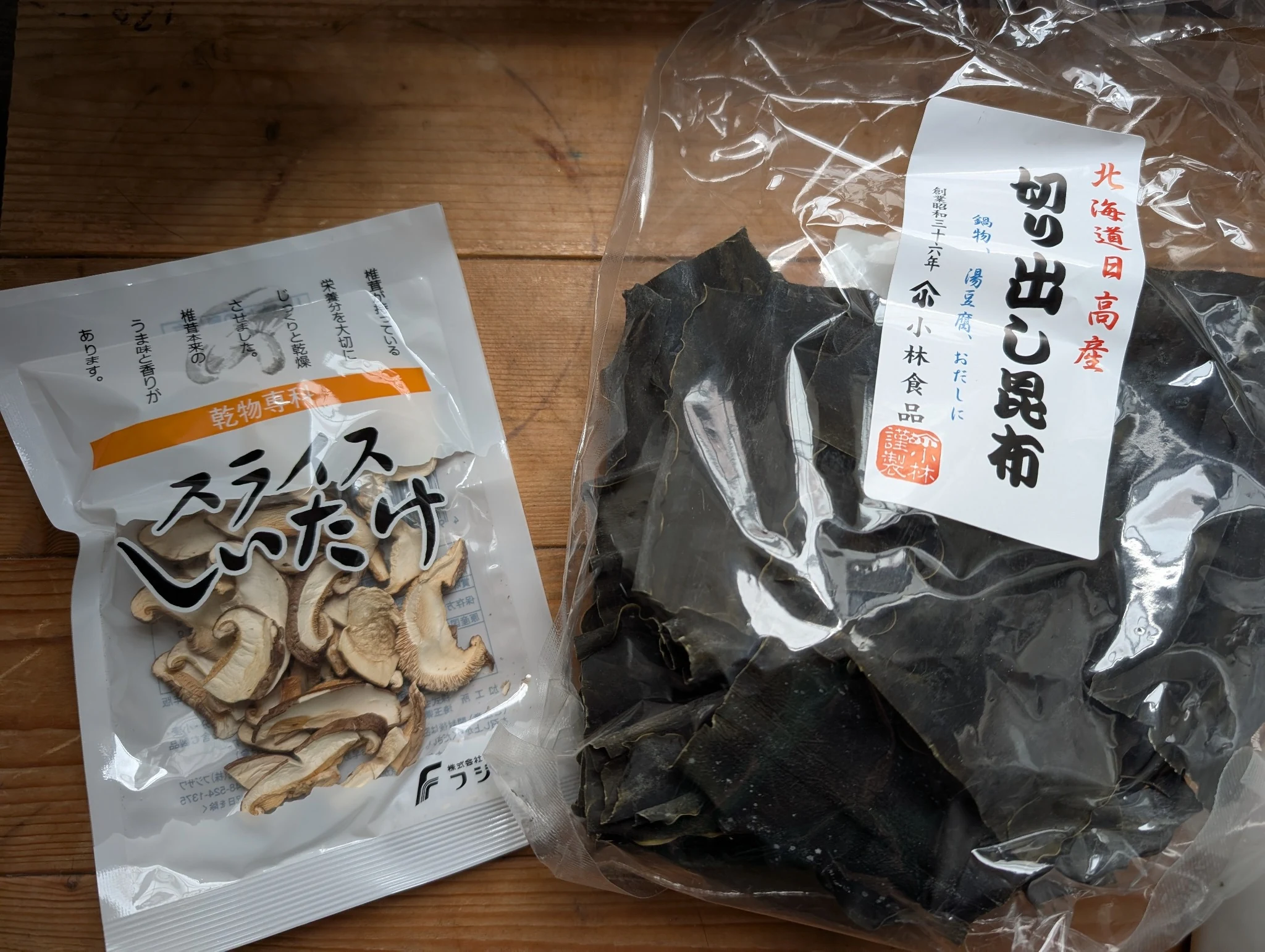
For the batch shown here, I used 15 g of kombu and one 10 g bag of sliced dried shiitake in 1 liter of water.
Ingredients
- 1 liter (about 4 1/4 US cups) water
- 15 g (0.5 oz) kombu
- 10 g (0.35 oz) dried sliced shiitake mushrooms
That's it—no soy sauce, miso, mirin, or salt yet. This is just the stock.
The Ingredients I Used
The kombu I used is sold in Japan as kiridashi kombu (切り出し昆布), kombu that's already been cut into manageable pieces. The dried shiitake came sliced in a 10 g bag. You'll notice I used sliced shiitake rather than whole mushrooms. That's simply what I had on hand, and weighing the mushrooms makes the recipe easy to repeat no matter what shape they're sold in.
In the U.S., look for kombu or dashi kombu. For the mushrooms, either whole or sliced dried shiitake will work; use the same weight.
How I Make It
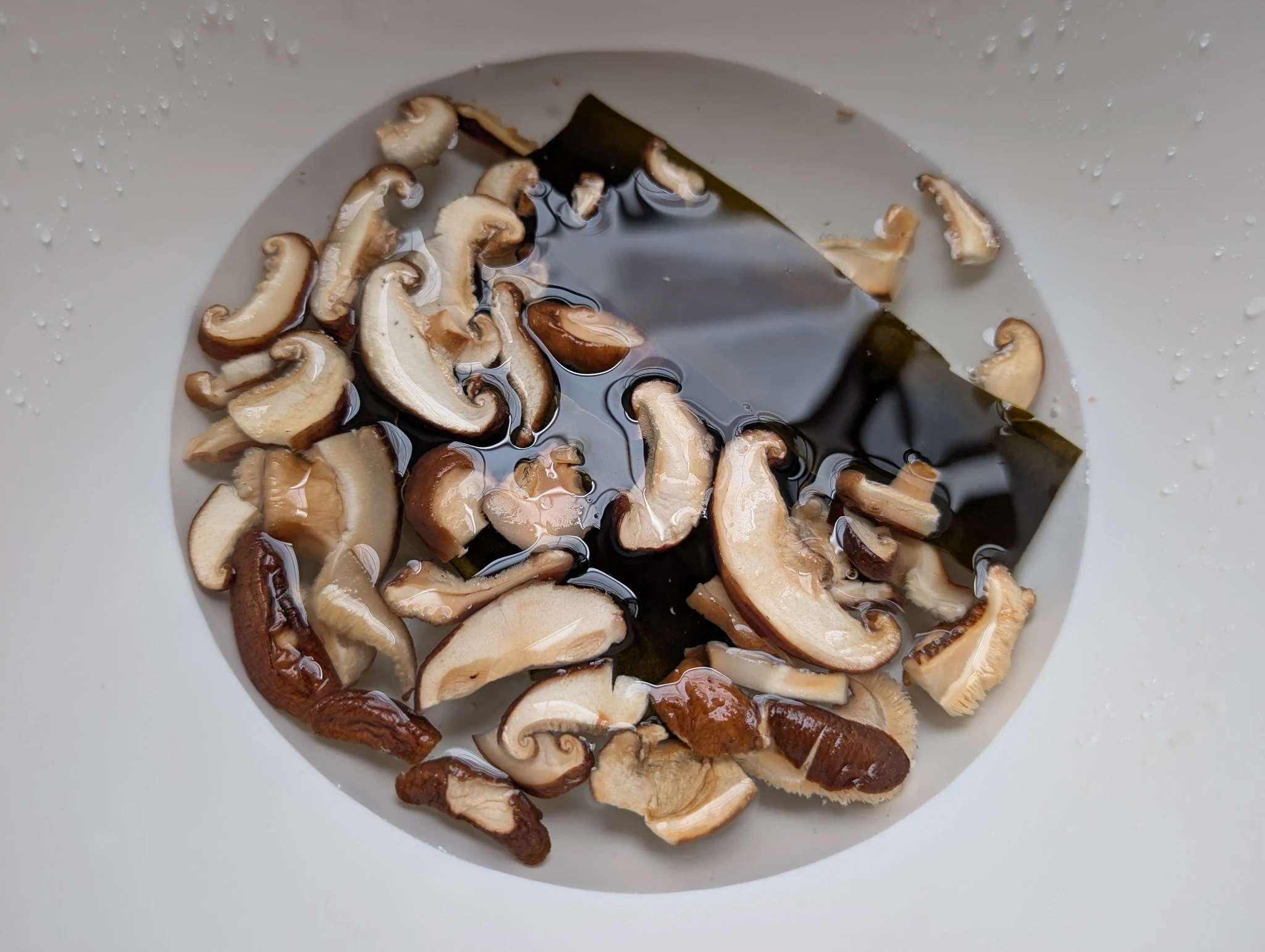
Put the kombu and dried shiitake in a clean container and pour in the cold water. If you're using sliced mushrooms like I did, just add them straight from the bag. Cover the container and put it in the refrigerator. I usually set up this kind of stock ahead of time rather than standing over a pot. Japan House London gives a minimum six-hour refrigerated soak for its kombu-and-shiitake dashi, while Soto Zen's basic shojin dashi uses a soak of at least three hours.
Leave this batch in the refrigerator for at least 6 hours or overnight. Once the stock has steeped, take out the kombu and shiitake. The liquid should be lightly golden and smell noticeably more savory than plain water.
You can use it as an ingredient right away or heat it as part of whatever you're cooking next.
What Does Kombu-Shiitake Dashi Taste Like?
Kombu-shiitake dashi isn't a strongly seasoned broth. Kombu gives it a clean savory base, and the dried shiitake brings a deeper mushroom aroma. I like it for dishes where I still want to taste the vegetables, tofu, miso, or noodles.
It doesn't taste exactly like bonito dashi, and I don't expect it to. It's its own stock.
How I Use It
At home, I use it most often for miso soup and simmered vegetable dishes. It also works for udon or soba broth, takikomi gohan, hot pots, and sauces that call for dashi. If a Japanese recipe simply says “dashi,” I still check what kind it was written for. Kombu-shiitake stock and a strong bonito or niboshi stock don't taste the same, even if they serve a similar role in the recipe.
I Don't Throw Out the Kombu and Shiitake
I almost never throw out the kombu and shiitake after one soak. Most often, I make tsukudani with them. I also use them in stir-fries or put them into miso soup. In the photo at the top, the golden stock is in the container at the back. The softened kombu and shiitake are in the bowl in front, ready to cook again.
That's how I normally use them at home.
Is This Dashi Vegan?
This batch is: water, kombu, and dried shiitake. Other Japanese dashi may contain katsuobushi, niboshi, or other fish ingredients. For ingredient names to look for on Japanese labels, see Is Dashi Vegan? How to Check Japanese Dashi for Fish Ingredients.
Another Stock I Make: Soybean Dashi
I also make dashi from roasted soybeans. It's a different stock, so I wouldn't add soybeans to this recipe and treat it as the same thing. Roasting changes the aroma, and the finished stock has a warmer, nuttier smell.
The Umami Information Center publishes a shojin recipe in which dried soybeans are roasted, added to hot water after the heat is turned off, left for half a day, and then strained. I used Hokkaido Tokachi soybeans for the batch I photographed.
Buying Kombu and Dried Shiitake Outside Japan
At a Japanese grocery store in the U.S., look for kombu, dashi kombu, or dried kelp specifically labeled for Japanese cooking. Don't substitute nori or wakame just because they're also sea vegetables. They're different ingredients and are used differently.
Dried shiitake are usually easier to find. Whole or sliced is fine for this recipe; weigh out 10 g. Online, useful search terms include kombu, dashi kombu, dried shiitake mushrooms, and sliced dried shiitake.
If you are shopping online, two options to look at on iHerb are Eden Foods Kombu, 60 g (paid link) and Shiloh Farms Organic Dried Shiitake Mushrooms, 28 g (paid link). Check the product pages for current availability and delivery options for your country.
Storage
Keep homemade dashi in a clean, airtight container in the refrigerator and use it within three days. Japan House London gives a refrigerated storage time of up to three days for its homemade vegan dashi.
Recipe: Kombu and Shiitake Vegan Dashi
Yield: About 4 cups
Prep time: 5 minutes
Soaking time: At least 6 hours
Cook time: 0 minutes
Total time: About 6 hours 5 minutes
Cuisine: Japanese
Diet: Vegan
Ingredients
- 1 liter (about 4 1/4 US cups) water
- 15 g (0.5 oz) kombu
- 10 g (0.35 oz) dried sliced shiitake mushrooms
Instructions
- Put the kombu and dried shiitake in a clean container.
- Pour in 1 liter of cold water.
- Cover and refrigerate for at least 6 hours or overnight.
- Remove the kombu and shiitake.
- Use the dashi right away, or refrigerate it in a clean airtight container for up to three days.
- Save the softened kombu and shiitake for tsukudani, miso soup, a stir-fry, or another dish.
Sources
- Japan House London — Making Vegan Dashi
- Soto Zen Buddhism — Shojin Dashi Preparation
- Umami Information Center — Shojin Cooking Recipes / Soybean-dashi
- Ministry of Agriculture, Forestry and Fisheries of Japan — The Washoku Way: Dashi Stock